

To further advance smart teaching reform, the Information Technology Development Office (ITDO), Academic Affairs Office (ACAO), and School of Graduate Studies (SGS) of Macau University of Science and Technology (MUST) jointly organized two specialized training sessions on “Empowering Smart Teaching with LAMS Platform and GenAI” on November 18, 2025. Conducted in both Chinese and English, the sessions attracted enthusiastic participation from faculty members who plan to adopt smart teaching models or have a keen interest in this field.
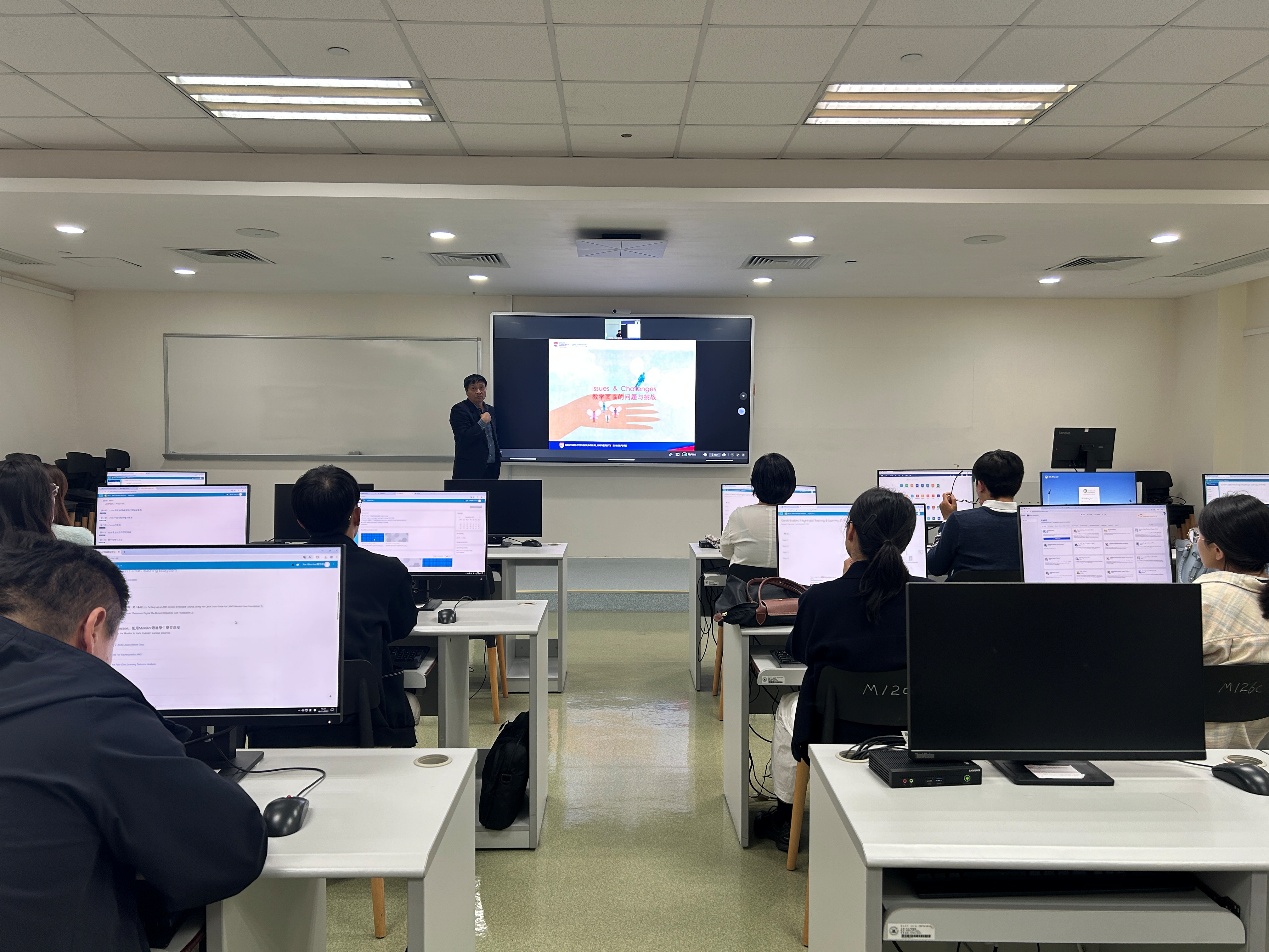
The training featured Professor Hong Huaqing as the keynote speaker. Professor Hong is a researcher at the Institute of Linguistic Science and Technology at Shanghai International Studies University; a researcher at the Centre for Research and Development in Learning at Nanyang Technological University, Singapore; director of the e-Learning Research and Development Center at the Lee Kong Chian School of Medicine. He holds the honorary position of Distinguished Councilor at the China Association for Corpus Linguistics and is an international expert at the Center for Teaching and Learning Development of Peking University. He also serves as a visiting professor at MUST, supporting the development of the university’s Future Learning Center. With extensive theoretical and practical experience, Professor Hong has long specialized in computer-assisted teaching, big data learning analytics, educational innovation, and corpus linguistics.
During the training, Professor Hong first shared NTU’s experience in teaching system reform and introduced how MUST’s Future Learning Center and Smart Teaching Platform support Team-Based Learning (TBL) and foster innovative teaching models. In the core segment, he provided an in-depth analysis of the diverse applications of Generative AI (GenAI) in instructional design. Through concrete examples and hands-on exercises, he guided faculty members on integrating GenAI tools into TBL workflows to enhance lesson preparation efficiency, enrich classroom interaction, and optimize learning feedback.
Following the sessions, Professor Hong engaged in lively discussions with participants, offering professional advice on curriculum design and teaching reform. Faculty members expressed that the training was highly rewarding and inspiring.
As the first event in MUST’s Smart Teaching Ecosystem Training Series for Semester 2602, this workshop successfully kicked off a six-session program. The series will continue in December with four exciting sessions, including “Introduction and Experience of MUST Smart Classroom” (in Chinese and English) and “Sharing Session on Smart Teaching Platform Usage” (in Chinese and English). In addition, an online practical course on the Smart Teaching Platform is actively being prepared. These initiatives reflect MUST’s vision for improving and innovating teaching models in the AI era, empowering educators, driving teaching innovation, and inspiring student engagement to jointly create a new landscape in education.

